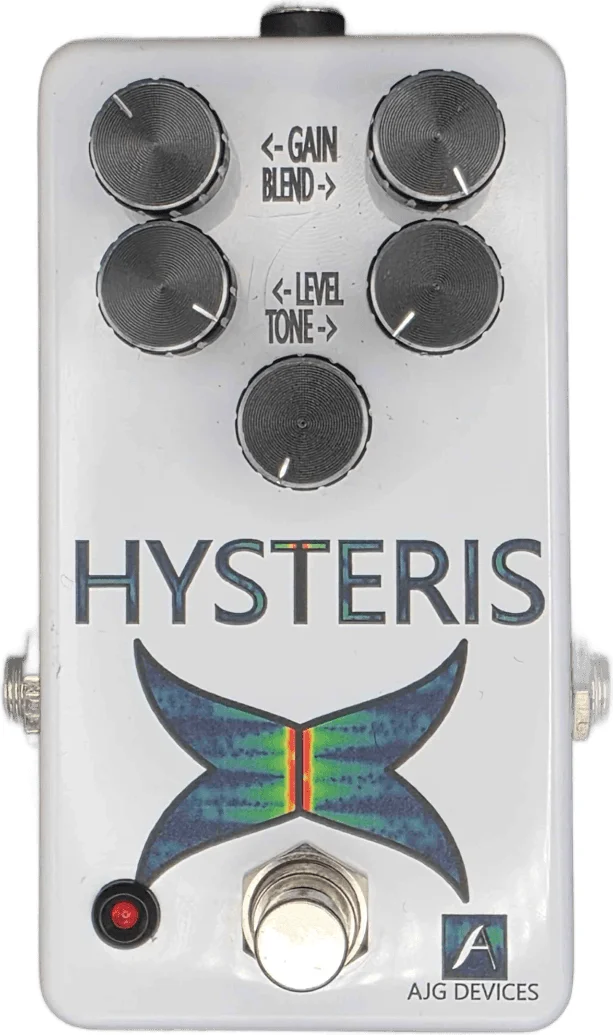
Hysteris
Distortion pedals almost always lean on the same trick of diodes or op-amp rails squashing the waveform. Hysteris deliberately does something stranger. This analog, openly experimental pedal runs two clipping mechanisms in parallel: a conventional op-amp saturation stage, and a hysteretic switching branch fed from it, then blends the two. The maker states it is not based on a traditional diode-clipping topology, and unstable or broken sounds are intentional rather than a flaw. The Hysteresis knob is the heart of the personality. At low settings the switching branch is unstable and the result is glitchy and gated; turn it up and the behaviour settles into something more predictable and recognisably like ordinary distortion. Blend decides how much of the hysteretic path is mixed in with the op-amp branch, and turning it clockwise pushes the tone toward fuzz. Gain sets the saturation stage and how hard the rest of the circuit is driven, travelling from overdrive toward heavier distortion. Tone is a low-pass filter whose cutoff drops as you turn it up, and Level handles output volume. The suggested starting point is every knob at noon, then adjusting Gain and Tone first and exploring Hysteresis and Blend from there. Housed in a 1590B enclosure with true bypass, it is a small, unpredictable box for players who want a distortion that can behave like a circuit on the edge of falling apart.